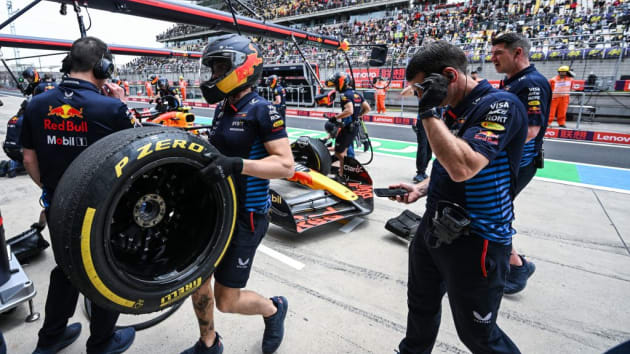
Wheels and tyres
Published with permission from the Federation Internationale de l' Automobile.
ARTICLE 12: WHEELS AND TYRES
12.1 Location:
Wheels must be external to the bodywork in plan view, with the rear aerodynamic device removed.
12.2 Number of wheels:
The number of wheels is fixed at four.
12.3 Wheel material:
All wheels must be made from an homogeneous metallic material.
12.4 Wheel dimensions:
12.4.1 Complete wheel width must lie between 305 and 355mm when fitted to the front of the car and between 365 and 380mm when fitted to the rear.
12.4.2 Complete wheel diameter must not exceed 660mm when fitted with dry-weather tyres or 670mm when fitted with wet-weather tyres.
12.4.3 Complete wheel width and diameter will be measured horizontally at axle height, with the wheel held in a vertical position and when fitted with new tyres inflated to 1.4 bar.
12.4.4 Wheel bead diameter must lie between 328 and 332mm.
12.5 Supply of tyres :
12.5.1 All tyres must be used as supplied by the manufacturer, any modification or treatment such as cutting,
grooving or the application of solvents or softeners is prohibited. This applies to dry, intermediate and wet-weather tyres.
12.5.2 If, in the opinion of the appointed tyre supplier and FIA technical delegate, the nominated tyre specification proves to be technically unsuitable, the stewards may authorise the use of additional tyres to a different specification.
12.5.3 If, in the interests of maintaining current levels of circuit safety, the FIA deems it necessary to reduce tyre grip, it shall introduce such rules as the tyre supplier may advise or, in the absence of advice which achieves the FIA's objectives, specify the maximum permissible contact areas for front and rear tyres.
12.6 Specification of tyres :
12.6.1 An intermediate tyre is one which has been designed for use on a wet or damp track.
All intermediate tyres must, when new, have a contact area which does not exceed 280cm² when fitted to the front of the car and 440cm² when fitted to the rear. Contact areas will be measured over any square section of the tyre which is normal to and symmetrical about the tyre centre line and which measures 200mm x 200mm when fitted to the front of the car and 250mm x 250mm when fitted to the rear. For the purposes of establishing conformity, void areas which are less than 2.5mm in depth will be deemed to be contact areas.
12.6.2 A wet-weather tyre is one which has been designed for use on a wet track.
All wet-weather tyres must, when new, have a contact area which does not exceed 240cm² when fitted to the front of the car and 375cm² when fitted to the rear. Contact areas will be measured over any square section of the tyre which is normal to and symmetrical about the tyre centre line and which measures 200mm x 200mm when fitted to the front of the car and 250mm x 250mm when fitted to the rear. For the purposes of establishing conformity, void areas which are less than 5.0mm in depth will be deemed to be contact areas.
12.6.3 Tyre specifications will be determined by the FIA no later than 1 September of the previous season. Once
determined in this way, the specification of the tyres will not be changed during the Championship season without the agreement of all competing teams.
12.7 Tyre Gases :
Tyres may only be inflated with air, nitrogen or CO2.
SEARCH INSIDE F1
TECHNICAL REGULATIONS
- Bodywork and dimensions
- Brake system
- Car construction
- Cockpit
- Electrical systems
- Engines and Kinetic Energy Recovery Systems (KERS)
- Fuel
- Fuel system and refuelling
- Impact testing
- Oil and coolant systems
- Roll structure testing
- Safety equipment
- Static load testing
- Suspension and steering systems
- Television cameras and timing transponders
- Transmission system
- Weight
- Wheels and tyres