|
Back in the founding years of Formula One racing, it was enough to glance up at the sky. Today, the teams invest a large amount of money and time in the most accurate weather forecasts possible, which they then use to help determine their race strategies. But despite state-of-the-art satellite technology, they are never entirely safe from unpleasant surprises. The approach of a rain front in particular sets off alarm bells with the strategists on the pit wall.
Even in Formula One racing, the weather does exactly what it wants to. The job of the meteorologists is one of the most delicate and thankless in motor racings top class. Nature does not always make their job easier, as at the 2004 Japanese Grand Prix, when a full-blown typhoon off the coast sent heavy rainstorms across the country and flooded the Suzuka circuit. Usually, their work consists of analysing a multitude of weather data and then drawing the correct conclusions. An incorrect forecast can have disastrous effects on the cars performance during racing.
The recommendations the meteorologists pass on to their teams strategists must take into account not only performance but also safety - on a wet circuit, the usual conditions are turned entirely on their head. If it rains, says Mark Webber to Williams sponsor Allianz, youre under much more pressure. If it starts to rain during the race, the drivers have to adjust to impaired visibility and other changed conditions within seconds. How late can I start braking? Should I race around the puddles? And most importantly: how much grip am I left with? The rubber build-up which improves the cars grip along the racing line is often washed away when it rains. As a consequence, the cars are more likely to slip and the drivers more likely to make a mistake.
Even the everyday motorist needs to be aware of additional hazards when driving on wet roads. Above a speed of roughly 70 km/h, a water depth of only a couple of millimetres is enough to reduce the tyres grip to less than 20 percent, Dr Christoph Lauterwasser of the Allianz Center for Technology explains. The water gets in between the tyres and the asphalt and in extreme cases the tyre actually begins to skate across the water, resulting in aquaplaning. The water therefore needs to be displaced through the grooves and channels of the tyres tread. Dr Lauterwasser says: At higher speeds, each tyre moves a body of water corresponding to several bucketfuls every second. That can only work if the tyre tread has sufficient depth. This should be at least three to four millimetres, which for wider tyres is the absolute minimum in wet conditions.
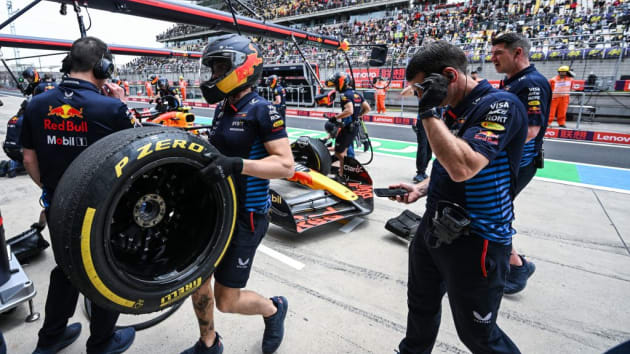
When the Formula One weather forecasters predict rain, the strategists on the pit wall start doing some serious thinking. The fact that the conditions during rainfall rarely remain constant, often changing from one minute to the next, poses a particularly difficult challenge. They need to determine the difference in lap times amid the changing conditions and then pinpoint the precise moment at which it will make sense to change from dry-weather tyres to intermediates or full wets - and vice-versa once the track begins to dry again. Its during the latter phase of drying that races are decided, as the lap times improve very quickly, says Sam Michael, Williams technical director.
The regulations of Formula One racing offer various options for reacting to rain. If it begins to rain just before the start, for example, the race director can abort the starting procedure, thereby providing the teams with the opportunity to change tyres. In heavy rain, he can order a rolling start following a lap behind the safety car, or postpone the start of the race. Should the conditions on the track become too dangerous because it begins to rain, or because the rain becomes heavier, he has the option of sending out the safety car. The teams can then change to intermediates or full wets. If that is not sufficient to ensure the drivers safety, the race can be aborted or restarted later.
While the teams used to have a lot of options for adjusting the cars to rain, the changes to the set-up allowed today are minimal: the cars must start the race with essentially the same set-up used during qualifying. Nevertheless, the teams always make preparations for a possible wet-weather race before every Grand Prix, even though serious changes to the basic set-up only make sense if it is absolutely certain it will be raining throughout the entire race, which is rare. According to the statistics, Formula One racing only experiences a pure wet-weather race once every ten years.
|