Q&A with McLarens Martin Whitmarsh
While McLarens time in Malaysia may have progressed less smoothly and garnered fewer points than their Melbourne visit, CEO Martin Whitmarsh remains confident the team will be able to improve their performance at the next race at Bahrain...
Q: McLaren was unable to repeat last years epic Malaysian Grand Prix one-two finish this time, but their lead in both Formula One world championships remains intact. What other positives can you take from the weekend?
Martin Whitmarsh: We knew it would be quite a challenge to beat Ferrari in Malaysia and I think, ultimately, we underperformed. We have drawn lots of positives from this seasons first two races, though. Im delighted with the way everyone is working, for instance. Lewis (Hamilton) and Heikki (Kovalainen) get along fantastically well and in my 19 years with the team, I dont ever recall seeing such an honest exchange of information between drivers.
Q: Lewis began and ended his weekend very strongly, but things seemed to go slightly awry in the middle, during qualifying
MW: He was certainly less comfortable with his cars balance on Saturday, but it was just one of those things. It had rained overnight, which cleaned the track. That might have been a factor, and then there was a wind direction change. People dont always appreciate how fluctuating ambient conditions affect the way a car behaves. Sometimes that works in your favour, sometimes it doesnt - and I feel that was what happened to Lewis. He felt very much at one with his car on Friday, but things just slipped away. We will look at that aspect of his weekend very closely and try to understand it before we go to Bahrain.
Q: The Sepang circuit has been resurfaced since last season. Might that have influenced things from a McLaren perspective?
MW: I dont believe so. The circuit certainly offered lower grip levels initially, but it evolved. The asphalt is darker than before and thus gets warmer, which creates a greater range of temperature variations, but Im sure it didnt affect us adversely.
Q: Heikki was unlucky not to finish second in Australia, where an unfortunately timed safety car worked to his disadvantage, so you must have been delighted to see him make the podium here
MW: Heikki did a terrific job. He and his crew developed his cars set-up to the point that he was quicker than Lewis in qualifying - even though he had a marginally heavier fuel load. He did an excellent job in the race, too. Despite a five-position grid penalty, for obstructing another car during qualifying, he recovered to finish third. Without it Im confident he would have been second. He was supposedly struggling for confidence last year, when people were starting to question his potential, but Im delighted to see how hard hes worked since joining McLaren.
Q: Lets go back to the qualifying penalties. Lewis and Heikki both lost five grid positions because they were adjudged to have impeded rivals. How did you see it?
MW: Usually, all the quickest cars are running simultaneously at the end of qualifying, but this time quite a few drivers - including ours - went out slightly early because there was a clear threat of rain. We ended up with a situation in which six cars arrived together at the same point on the circuit. Lewis and Heikki were two of four in fuel-saving mode, having finished their runs, while the other two were still flat out. We warned our drivers to keep out of the way, so they were aware of faster cars approaching, but in fairness Heikki looked in his mirrors and saw a number of cars, some to the left and some to the right. He could see a BMW that had switched to the right and had to make an instant decision about whether or not it was on a quick lap. He decided it would be dangerous to cut across the track if the car behind had a possible closing speed of about 200km/h (125mph). He and Lewis tried their best to keep out of the way, but I understand both the other drivers frustration and the stewards decision. It might seem harsh on the surface, but the officials need to send out a clear message and we respect that.
Q: Would you like to see the regulations changed, to avoid a possible repeat of situations such as this?
MW: You have to be careful not to shoot from the hip, but all teams are involved in the rule-making process and we missed something when the regulations last changed. Everyone backs off to save fuel, because the rules allow it, but in reality we shouldnt have a regulation that allows for closing speeds of 200km/h on a busy track.
Q: Lewis made a fantastic start and showed his customary verve by slicing from ninth to fifth within the first few corners. He looked set for yet another strong finish until he lost significant time at his first pit stop. What happened, exactly?
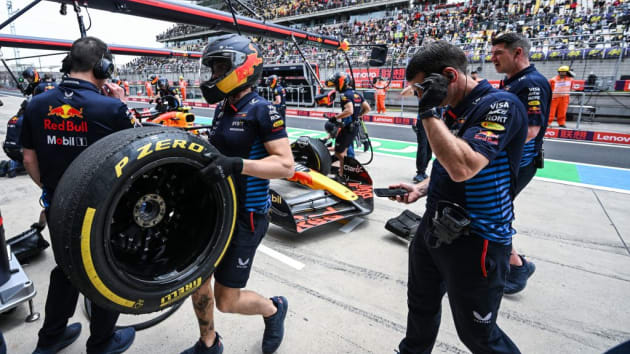
MW: The wheel-nut locking mechanism failed. When the gunman went to remove the nut it wouldnt come off. In the end he did a fantastic job because he switched to the spare gun and had to remove the pre-loaded wheel nut/hub cap. It appears to be a problem within the axle and the locking mechanism. Its something that hasnt happened before and it cost Lewis two things - 10 seconds in the pits and vital track position. It meant he spent much of his second stint behind Mark Webbers Red Bull and overtaking is notoriously difficult at Sepang. Without his problem, though, that fantastic first stint would have earned him a place on the podium.
Q: Next stop, Bahrain. What can we expect to see there?
MW: Our next major evolutionary step will be in Barcelona, but we tried one or two minor developments on the car in Malaysia and the same will be true in Bahrain. We have to make sure we perform better there. Were leading both world championships, so it hasnt been too shabby a start to the year, but we need to raise our game in Bahrain and carry that through into the European season.