




Mark Webber
For such a dedicated sports fanatic, Mark Webber came into the world of motor racing relatively late - aged 14. He first competed on motorbikes, but after trying his hand at karting - and notching up several state titles in his native New South Wales - the young Australian decided to stick with four wheels over two.
He moved into the Australian Formula Ford championship in 1994 and finished 14th. His first victories came the following year and included a memorable win in the support race for the Australian Grand Prix. Then came a startling international debut, Webber taking third place at the 1995 Formula Ford Festival in the UK.
That Brands Hatch outing helped him score a Van Diemen drive in the 1996 British Formula Ford championship. He made the most of the opportunity, winning four races on his way to the series runner-up slot. He also returned to Brands Hatch for the 96 Festival, this time emerging victorious.
Stepping up to British Formula Three in 1997, Webber took fourth place in the championship with compatriot Alan Dockings team. He added a third place in the Marlboro Masters at Zandvoort and a fourth in the Macau Grand Prix - successes that attracted the attentions of the Mercedes AMG sportscar squad, who signed him up for the 1998 FIA GT championship. Teamed with reigning world champion Bernd Schneider, Webber took five wins and only narrowly missed out on the title.
Retained by AMG for the reduced 1999 series, Webber was part of the teams doomed assault on that years Le Mans 24-hour race. Twice he survived unscathed after his Mercedes famously flipped at high speed, ultimately forcing AMG to withdraw from the event, and the season, prompting Webber to abandon his sportscar career and return his focus to single-seaters. Eddie Jordan introduced him to entrepreneur and fellow Australian Paul Stoddart, who was putting together a new Formula 3000 squad. After an impressive test outing Stoddart swiftly signed Webber to race in 2000.
A win, three podiums and third in the championship were the result, proving Webber hadnt lost his single-seater touch, and Stoddarts affiliation with Arrows boss Tom Walkinshaw also helped land him his first Formula One tests. Then Flavio Briatore and Benetton came calling and contracted Webber as test and reserve driver for 2001. As part of the deal, he continued competing in F3000 for the Super Nova squad. With his attentions increasingly on his F1 commitments, he finished second in the title race to Britains Justin Wilson, but more importantly secured a 2002 race seat with Minardi, now led by Stoddart.
A fifth-place finish in front of his home crowd on his Grand Prix debut was more than Webber, or indeed Minardi, could have hoped for. But it was no fluke and over the rest of the season he continued to surpass expectations, consistently out-qualifying team mate Alex Yoong, and racing much higher up the field than many thought his car should allow.
He progressed to Jaguar in 2003 where he continued to show the qualifying flair that was fast becoming a trademark - although the car was not overly competitive in race trim, Webber regularly pushed it to a top-ten grid slot, qualifying an amazing third in both Brazil and Hungary. He also won 17 of Jaguars 18 points that season and many were left wondering what the Australian could achieve with a top drive. However, sticking with the Ford-owned team for 2004, Webber was left frustrated by a downturn in their fortunes. Despite qualifying in the top six on three occasions, he scored just seven points all year and announced he would drive for Williams in 2005.
On paper the move should have been for the better, but Williams, one of the midfields leading lights in 2004, hit a dead-end. Webbers qualifying form remained as strong as ever, but 36 points and in tenth in the championship fell far short of his expectations. A second year with the British squad in 06 proved equally thankless and will be remembered as much for Webbers 11 retirements and his meagre seven-point tally as for his spectacular front-row grid slot in Monaco.
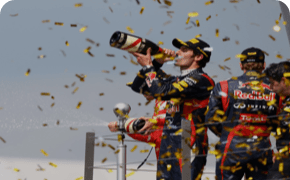
Calling time on his Williams career, Webber headed to Red Bull for the 2007 season. With Renault power and Adrian Newey design, the teams RB3 machine undoubtedly had potential, but its poor reliability meant Webber's regular top-ten qualifying performances rarely translated into points. The most notable exception was a deserved third place at the Nurburgring. Race pace was more the problem in 2008, when a fourth in Monaco was his best outing. His speed over a single lap remained unquestionable, however, as proven by his P2 grid slot at Silverstone - Red Bulls first-ever front-row start.
Preparations for 2009 were hampered by a broken leg sustained over the winter in a cycling accident. Nevertheless, as new team mate Sebastian Vettel stole the headlines with Red Bulls first win, Webbers campaign gradually gained momentum and round nine in Germany saw him finally clinch his first F1 victory in 130 starts. Though ultimately unable to challenge for the title, he won again in Brazil and finished the year a very respectable fourth in the standings.
Given that he was gifted with Red Bull's very quick RB6, Webbers 2010 season got off to a disappointingly slow start. But once hed got into the swing of things, victories in Spain, Monaco, Britain and Hungary more than made up for it. There were blips, including a collision with team mate Vettel in Turkey, but he arrived at the season finale as one of four drivers still in with a shot at the title. Poor pit strategy during the race, however, saw him eventually finish third overall.
The 2011-spec Red Bull was even more dominant than its predecessor but Webber spent the season in the doldrums, lacking both form and fortune. Pushed into the shadows by Vettel, who scored 15 pole positions, 11 victories and a second successive world title, Webber managed just three poles and a single victory (at the season finale in Brazil).
Staying with Red Bull for 2012, Webber was determined to make amends and the banning of exhaust-blown diffusers, which Red Bull had utilised so well in 2011, suited the Australian who had struggled to adapt to the particular driving style they required.
2012 began with four consecutive fourth places before he finally made it onto the podium, and the top step no less, in Monaco. He added a second victory at the British Grand Prix in July and for a while looked a genuine title contender, before his form (and to some extent his luck) dipped in the second half of the season, just as team mate Vettels improved. He ended 2012 - a season in which he signed a new contract to continue with Red Bull in 2013 - sixth in the championship, 102 points down on Vettel.


