Driving protocol and penalties
Stewards have the power to impose various penalties on a driver if he commits an offence during a race. Offences include jumping the start, causing an avoidable accident, unfairly blocking another driver, impeding another driver when being lapped or speeding in the pit lane.
Drivers may not leave the track without a justifiable reason, i.e. cutting a chicane on reconnaissance laps or in-laps to save time and fuel, and more than one change of direction to defend a position is not permitted. If a driver has moved off-line to defend a position, they may move back towards the racing line but must ensure there is at least one cars width between his own car and the edge of the track.
The two most common types of penalty are the drive-through penalty and the ten-second time penalty. In the case of the former, the driver must enter the pits, drive through the pit lane at the pit-lane speed limit and rejoin the race without stopping. Depending on the length of the pit lane this can cost a driver a significant amount of time.
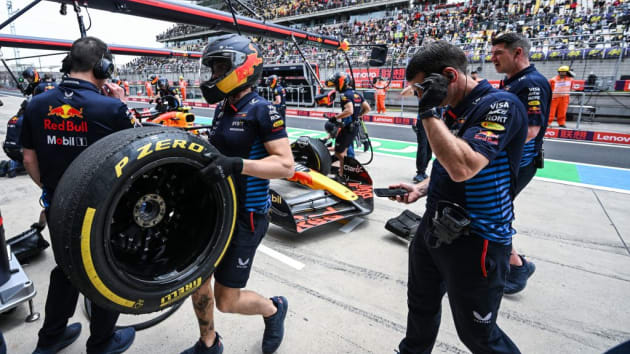
More severe is the ten-second time penalty (also commonly known as a stop-go penalty) where the driver must not only enter the pits, but must also stop for ten seconds at his pit before rejoining the race. During this time the drivers team are not permitted to work on the car or change the cars tyres.
In the case of the drive-through penalty and the ten-second time penalty, a driver has three laps, from the time his team is notified, to enter the pits (failure to do so may result in a black flag and the driver being excluded from the race).
The only exception is when the penalty is awarded during the final five laps of the race. In this case the driver may continue and complete the race. Twenty seconds will be added to his total race time in lieu of a drive-through penalty, or 30 seconds in place of a ten-second time penalty, either of which may drop him considerably in the final race standings.
In extreme cases stewards may choose to enforce tougher penalties. They can drop a driver any number of grid positions at the next Grand Prix (so, for example, if the driver in question goes on to qualify on pole, a ten-place penalty would for drop him to 11th). They can also impose time penalties, reprimand a driver, exclude him from the results, or suspend him from the next race.
Any driver receiving three reprimands for driving infringements during a season will automatically receive a ten-place grid penalty for the current or next event.
SEARCH INSIDE F1
SPORTING REGULATIONS
- 2013 season changes
- Car livery
- Classification
- Drag Reduction System
- Driver changes and additional drivers
- Driving protocol and penalties
- Officials
- Parc Ferme
- Pit-lane procedures
- Points
- Practice and qualifying
- Race distance
- Race start procedure
- Safety car
- Scrutineering and weighing
- Spare cars, engines and gearboxes
- Suspending and resuming a race
- Testing
- Tyres