ce 38 Formula 1® - The Official F1® Website e47 7c1 Formula 1 - News Index
1ca

Home - The Official Formula 1 Website Skip to content

3c

Pit-lane procedures

Published with permission from the Federation Internationale de l' Automobile.

23) PIT ENTRY, PIT LANE AND PIT EXIT
23.1 The section of track between the first safety car line and the beginning of the pit lane will be designated the “pit entry”.
23.2 The section of track between the end of the pit lane and the second safety car line will be designated the “pit exit”.
23.3 The pit lane will be divided into two lanes, the lane closest to the pit wall will be designated the "fast lane" and may be no more than 3.5 metres wide, the lane closest to the garages will be designated the "inner lane".
Other than when cars are at the end of the pit lane under Articles 38.2 and 41.5, the inner lane is the only area where any work can be carried out on a car. However, no work may be carried out in the fast lane if it is likely to hinder other cars attempting to leave the pit lane.
23.4 The FIA will allocate garages and an area in the pit lane on a strictly equal basis where each team may work and, within each of these designated garage areas, one position where pit stops during both practice and the race may be carried out.
23.5 Powered devices which assist in lifting any part of a car are forbidden in the pit lane during a race.
23.6 Unless a car is pushed from the grid at any time during the start procedure, cars may only be driven from the team's designated garage area to the end of the pit lane.
Any car(s) driven to the end of the pit lane prior to the start or re-start of a practice session, or any car(s) required to stop at the pit exit during a safety car period, must form up in a line in the fast lane and leave in the order they got there unless another car is unduly delayed.
23.7 Any driver that is required to start the race from the pit lane may not drive his car from his team's designated garage area until the 15 minute signal has been given and must stop in a line in the fast lane.
Under these circumstances working in the fast lane will be permitted but any such work is restricted to :
a) Starting the engine and any directly associated preparation.
b) The fitting or removal of permitted cooling and heating devices.
c) Changes made for driver comfort.
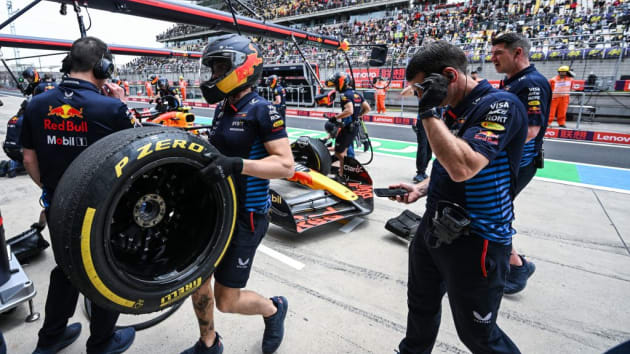
d) Changing wheels.
When cars are permitted to leave the pit lane they must do so in the order that was established under Article 38.2 unless another car is unduly delayed. At all times drivers must follow the directions of the marshals.
23.8 Other than drying, sweeping or any tyre rubber left when cars leave their pit stop position, competitors may not attempt to enhance the grip of the surface in the pit lane unless a problem has been clearly identified and a solution agreed to by the FIA safety delegate.
23.9 Competitors must not paint lines on any part of the pit lane.
23.10 Other than under 23.7 above no equipment may be left in the fast lane.
23.11 Team personnel are only allowed in the pit lane immediately before they are required to work on a car and must withdraw as soon as the work is complete.
23.12 It is the responsibility of the competitor to release his car after a pit stop only when it is safe to do so. The competitor must also provide a means of clearly establishing, when being viewed from the front of the car, when that car was released.
23.13 Under exceptional circumstances the race director may ask for the pit entry to be closed during the race for safety reasons. At such times drivers may only enter the pit lane in order for essential and entirely evident repairs to be carried out to the car.
29) REFUELLING
29.1 a) Refuelling is only permitted in the team's designated garages.
b) No car may be refuelled after it has left the pit lane to start the first reconnaissance lap permitted under Article 38.1.
c) Fuel may not be added to nor removed from a car during a race.
29.2 No car may be refuelled, nor may fuel be removed from a car, at a rate greater than 0.8 litres per second.
29.3 The driver may remain in his car throughout refuelling but the engine must be stopped.
29.4 During all refuelling or fuel handling operations :
a) The relevant personnel must be wearing clothing which will provide adequate protection against fire.
b) An assistant, wearing clothing which will provide adequate protection against fire, and who is equipped with a suitable fire extinguisher of appropriate capacity must be present.
c) All cars, refuelling equipment and containers must be suitably grounded where necessary.
d) Any powered pumping system used to transfer fuel must be operated by a non-latching switch or be turned off automatically if the operator leaves.

e4a
1c cc
d95
4a6 d1
 
e17 9a
0