ce 38 Formula 1® - The Official F1® Website e47 7c1 Formula 1 - News Index
1ca

Home - The Official Formula 1 Website Skip to content

3c

Pit stops

Felipe Massa (BRA) Ferrari F2012 makes a pit stop.
Formula One World Championship, Rd2, Malaysian Grand Prix, Race, Sepang, Malaysia, Sunday, 25 March 2012 Nico Rosberg (GER) Mercedes AMG F1 W03 makes a pit stop.
Formula One World Championship, Rd3, Chinese Grand Prix, Shanghai, China, Sunday, 15 April 2012 Jenson Button (GBR) McLaren MP4-27 makes a pit stop.
Formula One World Championship, Rd2, Malaysian Grand Prix, Race, Sepang, Malaysia, Sunday, 25 March 2012

Drivers get most of the attention, but Formula One racing remains a team sport even during the race itself. The precisely timed, millimetre perfect choreography of a modern pit stop is vital to help teams to turn their race strategy into success - changing a car’s tyres, replacing damaged parts and adjusting front wings in a matter of seconds.

It was not always so. Pit stops tended to be disorganised, long and often chaotic as late as the 1970s - especially when (in the absence of car-to-pit communication) a driver came in to make an unscheduled stop. The age of the modern pit stop arrived when changes were made to the sporting regulations for the 1994 season to allow fuelling during the race. By the time refuelling was banned again at the end of 2009, a driver’s visit to the pits had become breathtaking in its speed and efficiency.

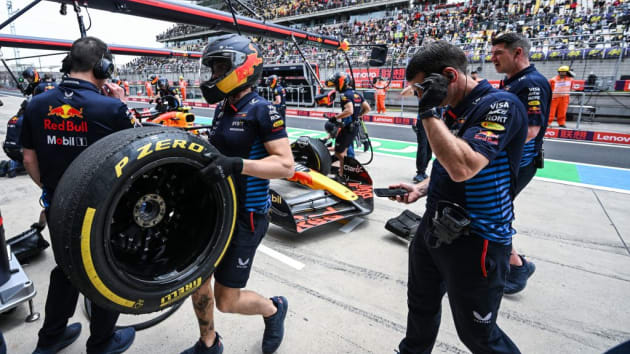
The car is guided into its pit by the ‘lollypop man’, named for the distinctive shape of the long ‘stop/ first gear’ sign he holds in front of the car. The car stops in a precise position and is immediately jacked up front and rear. Three mechanics are involved in changing a wheel, one removing and refitting the nut with a high-speed airgun, one removing the old wheel and one fitting the new one.

Other mechanics may make other adjustments during the stop. Some changes can be carried out very quickly - such as altering the angle of the wings front and rear, to increase or decrease downforce levels. Other tasks, such as the replacement of damaged bodywork, will typically take longer - although front nose cones, the most frequently broken components, are designed with quick changes in mind.

On tracks with debris or rubbish you often see mechanics removing this from the car’s air intakes during a stop, ensuring radiator efficiency is not compromised. And there is always a mechanic on stand-by at the back of the car with a power-operated engine starter, ready for instant use if the car stalls.

When they have finished their work the mechanics step back and raise their hands. It is the responsibility of the ‘lollypop man’ to control the car’s departure from the pit, ensuring no other cars are passing in the pit lane, though some teams now use semi-automated traffic light systems instead of the lollipop. Such is the skill of mechanics that routine tyre stops can be over in under three seconds.

e34
1c cc
b8a
4a6 d1
 
e17 9a
0