Life on the Wire - the Formula One Race Engineer Unravelled 09 Sep 2009
Their voices stop television commentators in their tracks as they take over the air waves and issue instructions to a driver, but a race engineers job entails much more than being a pit-to-car messenger. From strategist to diplomat, from decision maker to motivational guru, its a complex and demanding role.
One of the most experienced in the business is Brawn GPs Jock Clear, race engineer to Rubens Barrichello. From guiding Jacques Villeneuve to the world title in 1997, to his recent triumph as the man behind Barrichellos Valencia victory, Clear remains at the very top of his game. In the first of a three-part feature, Formula1.com caught up with him to find out more about one of the most important positions in the paddock.
For casual Formula One fans, the race engineers most obvious presence during a Grand Prix weekend is his conversations with his driver over the radio. Whether its a blurted-out order to pit as rain begins to fall, a warning to take it easy for the sake of the tyres, advice to pick up the pace ahead of an in-lap, or just relaying how the race is panning out, its a pivotal part of their job.
As the teams go-between linking cockpit and pit wall, a race engineer provides the driver with all the information (strategy, lap times, tyres temperatures etc) that he needs to get the job done. He will also pass on any data that could help the driver improve his pace, let him know if he needs to adjust engine settings to conserve fuel, or tell him what his rivals are up to. It goes both ways, so as well as relaying information, the engineer must listen to the drivers responses and interpret these messages quickly, before passing them on accurately to the rest of the teams support engineers. With these facts at their fingertips, the whole team can then work on measures to improve the cars set-up, handling, and performance to better suit the drivers demands.
The dialogue between the two that you see on the television is the thing that people most relate to, explains Clear, when asked to describe his job to the layman. Youre the direct conduit between the driver and the 400 people in the team. Interpreting the feedback is important too. Obviously the driver isnt an engineer, so you need to then translate (what he says) into engineer speak. You really are the eyes and ears of the rest of the factory, as far as the driver is concerned and vice versa.
As well as being chief envoy between driver and team, Clear will also help make the key decisions that will shape his drivers strategy over a Grand Prix weekend. Of course, the days of tactics being the domain of two or three team members are long gone; theres now a whole gaggle of engineers working to find the best practice, qualifying and race plan. However, Clear (and his fellow race engineers up and down the pit lane) remains an intrinsic part of this process, assisting the team in deciding on fuel loads, tyre choice and the timing of qualifying runs.
Strategy is a group thing now, confirms Clear. I would say that James Vowles, Brawn GPs strategy engineer, is pretty much in charge of what goes on a race day. But again, on the basis of all thats gone before, myself, Rubens, Jenson (Button), and (Buttons race engineer) Andrew Shovlin are all involved throughout the weekend.
So come race time, James is effectively choreographing the show, having been through rehearsals with all the rest of us. Its testament to how well you work as an engineering group and how well youve done your homework. We shouldnt have debates on the pit wall. If its a set of circumstances that you didnt foresee then you just didnt do your homework.
But Formula One racing is anything but predictable, and however painstakingly organised the team is, there will always be moments of uncertainty, where things just dont go to plan and disorder reigns. Be it a safety car, a sudden shower, or a puncture, anything can happen and not every eventuality can be planned for. And its at this point, when time is limited, that Clear has to take control, helping his driver settle on a course of action in little more than a heartbeat. Its not something just anyone can be good at.
You need to make decisions - simple as that really," says Clear. "And youve never got the luxury of having all the information available to you. So you always have to make decisions with whatever information you do have available at that time. And as much as youd like to wait a couple of minutes to see if it is going to rain, for example, those extra couple of minutes might be too late and youve missed the window.
So you invariably have to make decisions on the thinnest of information. And thats something some people dont like doing. If youre a pure scientist your gut feeling is that you cant make a decision yet, youll have to wait for some more information. But obviously sport doesnt allow you to do that. So theres a huge emphasis on simply being able to make a decision. The whole team has got to know what to do in any given circumstance, and no decision is the worst thing you can do.
One of the most surprising things is that an engineer can make these decisions on the spot and then communicate these speedy demands to the driver in the same calm and collected manner that he was chatting about front-wing adjustments during Friday practice. For Clear, this unflappability is an essential part of the job.
Its only the pressure of time that makes you excitable. Youd be surprised at how quickly you need to make decision at key times. You are talking matters of seconds. You can take in the region of three to five seconds to get the most basic of information across, but in some circumstances three to five seconds is too long. So you simply have to try and get information across stupidly quickly.
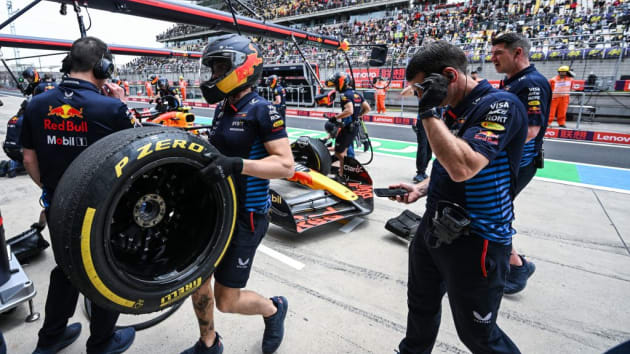
One circumstance that comes to mind is in Singapore last year when the safety car came out when Piquet crashed. Im sure the radios were flying between Red Bull and us, because we were the four cars who could pit before the safety car got out. Three out of the four did it. Jenson failed to get in, but Webber, Coulthard and Rubens all got in and got the jump so to speak. Its that circumstance where it will sound very panicky but its in that case that you dont have three seconds to say a phrase to get the information to the driver. Youve got to get it out faster than that - and the only way of doing that is to say it fast and loud.
As in all aspects of the sport, speed is evidently imperative. And Clear believes that this ability to be flexible enough to take a punt on a spur-of-the-moment strategy change is vital for a race engineer to be good at his job. He does, however, admit that its an inexact science - and one that can have mixed results.
The fact is when you have to make decision with a lack of information, inevitably, you will get it wrong sometimes, he says. The skill of a race engineer is to demonstrate that over the course of a season or whatever, hell be right more often than hes wrong. But its making those judgement calls and being better at it than average that makes a successful race engineer.
To read Part Two of this feature, click here.
To read Part Three of this feature, click here.