Bad weather meant the teams did over 600 fewer laps at this year’s opening test than 12 months ago – but that didn’t prevent some from unveiling intriguing new technological developments. And one of the more eye-catching came from McLaren…
The Woking team have always been keen on using the rear suspension to improve the aerodynamics at the rear of the car, and the late switch from Honda to Renault power wasn’t going to stop them making it a priority once again for the MCL33.
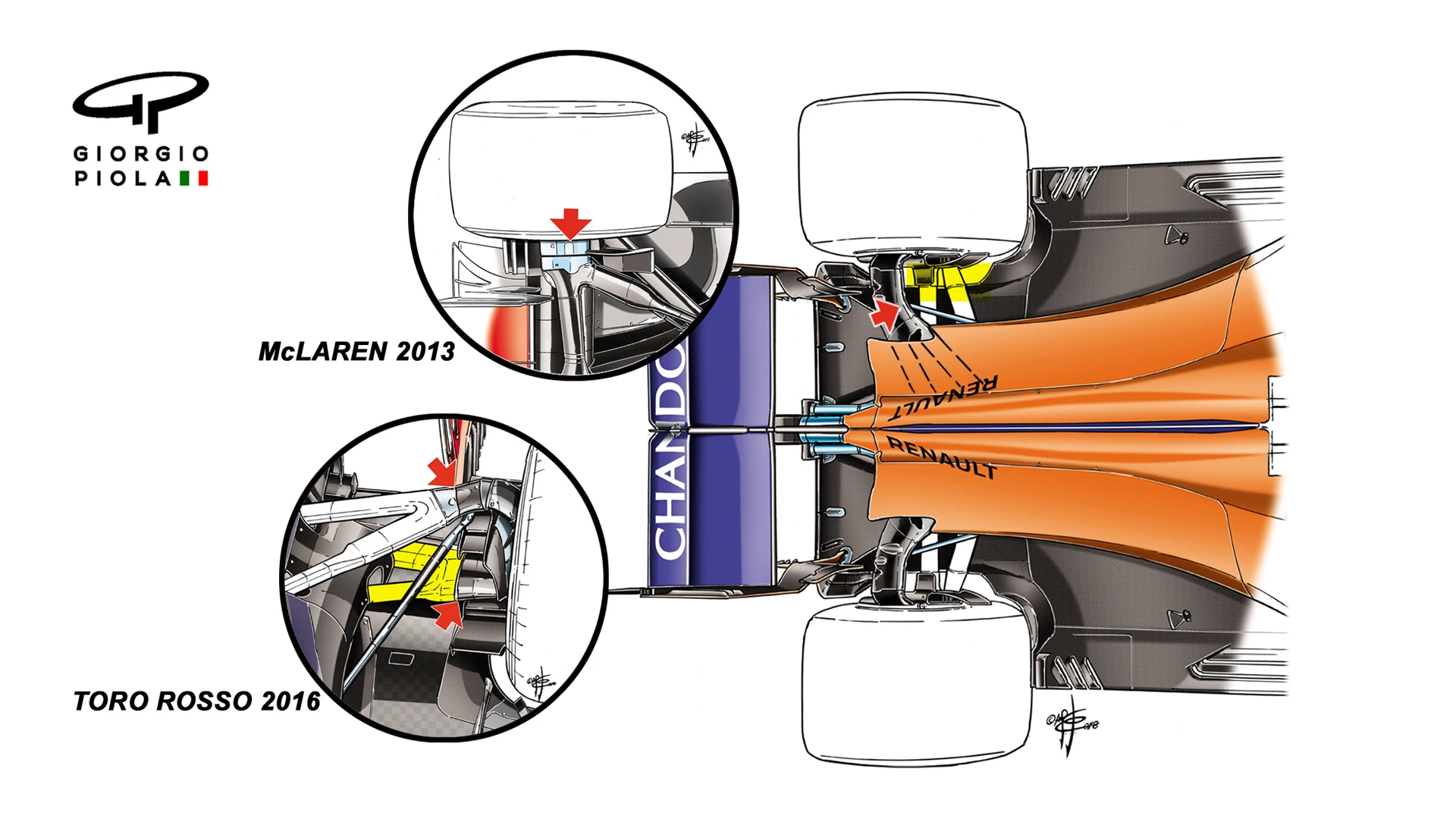
This year’s super aggressive design (above) sees the team using a big bracket on the top wishbone, similar to what they introduced to F1 for the first time in 2013 (see inset). The top wishbone is angled very far forward, which produces a very narrow triangular shape, not unlike Toro Rosso's lower wishbone of 2016 (see inset).
What makes the design so advantageous aerodynamically is that the pick-up point of the pushrod link is not close to the upright, but nearly in the middle of the top wishbone, freeing up the area around the rear tyre and thereby improving airflow in that area of the car.
Of course, this approach isn’t without its potential drawbacks, and McLaren will have had to have done their sums to make sure the advantage they gain aerodynamically compensates for the handicap of having to make the top wishbone much heavier in order to guarantee the necessary stiffness.
Next Up
Related Articles
 Verstappen baffled after missing out on Austin pole
 UnlockedWhy Alonso seems as hungry as ever 20 years on from his last title
 Leclerc your US GP Driver of the Day after fighting drive to P2
 Bemused Wolff celebrates Antonelli’s ‘miracle lap’ in the US
 AS IT HAPPENED: Third practice in the United States
 OFFICIAL GRID: Who starts where for the United States Grand Prix